By the Water with Friends
By Danielle Zilberberg
A pregnant woman lays naked in a bathtub filled with amber water. She has a serene yet intense expression, with her eyes slightly open and her head tilted back. The lighting is warm and moody. It emphasizes the contours of her slender body and her prominent pregnant belly. Her long black hair unfolds reassuringly in the water like a hand fan, cooling and understated. It’s artistic. Calm. Tastefully sexual. It’s an Instagram post. The wall beside the bathtub peaks through, marble or concrete, hinting at an industrial background, like a relic in an exhibition.
It looks like pee.
Yuriko was trying some aromatic oils that are meant to induce labor. Some
Chilean witch doctor in Santiago, her new home, gave them to her. It’s not the
first time she’d taken the alternative route. How could she not – she didn’t
even speak the language.
She didn’t plan to be pregnant, but then again, she didn’t plan. Yuriko
trusted the universe. Life’s ebb and flow would go easy on her. She’d be
different from her parents.
As her belly grew and time kicked on, she started to realize that having help to carry it, is not the same as carrying it. That it takes more than a village to escape yourself.
She was far from home.
She didn’t know the way back.
She was making a new home.
Does it work like that?
The oils helped her relax, despite the restless human gestating inside of her – women can tell you all about it, though they aren’t often asked.
Her eyes are shut. Her left hand cradles her right breast, creating a semblance of modesty. Her big belly looks as if it’s floating to the surface of the water. She could have been one of Damien Hirst’s artworks – a body in a body in a body of water. Mise en abyme. On Instagram, everything is possible.
The thin bikini tan lines along her lower hip and her small breasts attract the eye to her private parts, once skimpily covered and out in the public sun as if to say ‘I’m comfortable in my own body’. Had it not been on Instagram, one might imagine she didn’t care about the gaze. I can imagine her prancing along the Chilean beach in her bikini with the effortless abandon of a child, exuding that cool nonchalance that makes women like me self-conscious. It’s always elusive with women like Yuriko.
The camera is held by someone who loves her, Noah, who sees her and her desire to be known. In Berlin, years ago, when I first met her, it was winter and she lived by a playground in Prenzlauer Berg. Every morning she’d go down to the cafe on the corner for a coffee and kuchen and look at the young mothers, some pregnant again, playing with their young children in the icy jungle gym. They get a full year of maternity leave there. At the start of the 21st century, Germany was a good place to raise children. She felt at home there in a way she didn’t quite understand or question.
Yuriko used to think that there was something pervasive about the pregnant woman’s body. Everyone – strangers on an U-bahn, colleagues, fathers, your husband’s parents and all his friends, the Uber driver – everyone could see your pregnant body and know that you had had sex. It was like walking around fully dressed and respectable, going about your daily business with a calendar pinned to your belly marked X on the day when you had had sex, and someone had cum inside you. Not just sex with a condom or while on some sterilizing pill; someone grunted and climaxed and then came inside your body – “everyone, come see!”
She hadn’t thought like that lately. As she lays in the bath, she’s aware of Noah’s eyes on her and obviously likes the result – hence the Instagram post. Yuriko is not the timid type, even though she was raised in a home with no touch. She’s a great hugger, in spite of it. A great dancer because of it. She uses her body to get what she wants.
She went to Berlin for the dance scene. She survived the brutal winter on the Berghain dance floor, late morning slices of cake einen Kaffee mit Milch, and evening Deutsch classes. When her visa ran out, she folded her home into her suitcase like origami and flew to Tel-Aviv. She went gaga for Gaga. She dreamed of moving as if honey flowed through her veins, with an edible gooeyness. She took a room in a dorm in a hostel by the beach. She didn’t talk much about where she came from. Yuriko was looking forward.
One weekend, we shared a moment floating together on the Dead Sea. Bodies in a body of water, though it’s not clear why we call it water. The whole way there in the car Yuriko sat in the back, and, leaning forward between the two front seats where Tamar and I sat, she retold the story of the Australian in the hostel who wanted her body for the night.
She had never been to the desert. As the red Fiat Punto glided down the hills
of Jerusalem, a big blue bath revealed itself in the middle of the barren
landscape, sun-bleached and piercingly calm.
“It’s undrinkable”, we told her. “There are no fish in it. Nothing survives.”
“Is it deep?” she inquired.
“Very,” we said, enjoying the legitimacy we felt about our lives in her
presence. “It’s as deep as two Empire State buildings, one on top of the
other.” We all paused to think about that.
“Don’t get it in your eyes,” we dramatized.
She had shaved her bikini line the day before. We didn’t have the heart to
warn her about the pain that awaited. Women can tell you all about pain, but
they aren’t often asked.
We ate salt and vinegar chips in the car.
She taught us that a “little pig” in Japanese is “Onishishi” and we laughed at
the fact that there’s a word for that.
We gossiped about the Batsheva dancers. Gosh, they can dance.
And then she met Noah. Like Yuriko, he experimented with his body. Sometimes
he tested the limits of what he could stand. They didn’t have a shared
language, so they had to meet in English. They must have had electric sex.
When her visa ran out again, I lost track of her. Seven years later, she lay
on my phone screen on display in the yellow bath, soaking in the oily water –
a different kind of undrinkable – freckles from the equatorial sun sprinkling
her body.
Click.
She gave birth in that bath too, but that’s another story.
Click.
I go back to my profile in search of photos from our road trip. I scroll past a photo of a white woman in her early thirties, sitting on the floor of a museum with her legs bent, feet flat, and arms wrapped around her knees. She gazes directly into the eyes of a taxidermied lamb suspended in a glass aquarium filled with sky-blue liquid, framed in white. She’s dressed in a dark floral dress – very LA – and black ballet flats. Her wavy bob frames her face that is both aware of the camera and consciously shying away from it. She doesn’t like being seen yet craves attention. Other tourists appear as reflections in the glass, hovering behind the lamb in the tank, adding depth to the scene. It goes without saying that the lamb is in fact dead. Oh my.
Her posture mirrors the positioning of the lamb, creating a contemplative, almost eerie symmetry – one that seems lost on her. Looking at it now, I’m reminded of Roland Barthes’ assertion that when in front of the camera “I am, at the same time: the one I think I am, the one I want others to think I am, the one the photographer thinks I am, and the one he makes use of to exhibit his art,” (Camera Lucida: Reflections on Photography).
Noah took the photo of me. He was not very interested in my body as such. I’m
not sure he was interested in any-body unless it hosted a person who could get
him an invitation to the Cannes Film Festival, a work of original art for his
collection, or a home cooked meal. I was no Martha Stewart.
I had always had a lurking urge to unzip my life and see what lay beneath. As
if I, too, my ‘real’ self was suspended in a body. My body.
Maybe I could reincarnate during this life as a Los Angeleno.
Damien Hirst’s lamb, next to whom I was photographed, was on display at The
Broad Museum in LA. They have an incredible collection of contemporary art –
which I, more often than I care to admit, referred to as modern art, to Noah’s
chagrin. I had taken multiple photos with my phone of the art works, who knows
why and for whom, and as I came across the lamb I paused and knelt beside it.
“Away from the flock” it’s called.
Click.
He directed my posture and pose, and I remember feeling exposed. Away from my flock. Noah adjusted the angle. “Turn your head more. Look like you’re in love with the lamb. Art is so fucking emotional.” It was the closest we came to love.
I posted the photo and tagged him and the museum. “Made a new friend”, I
captioned it, thinking I was cute.
On Instagram we elevate these pseudo-presences that were never meant to last.
“Lol!” “So Cute!” “You look so happy!” – my friends back in Tel Aviv
commented.
My iPhone recently curated these two photos in a new collection of “Memories” and called it “By the water with friends”. It edited the reel with a cheerful song in the background. In between my preservations of Yuriko in the bath and myself by the dead lamb, it strung photos of me, poolside on a couple of occasions, on the ferris wheel at Venice Beach, a photo from a picnic by a river, from our trip to the Dead Sea, and one of LA-Noah drinking beer on the beach.
When I snapped the screenshot of Yuriko in the bath, in that formaldehyd-esque yellow-tinted formula – I was pumping milk for my newborn daughter after an emergency C-section that had saved her, but, while so doing, severed me from my body and my ability to breastfeed.
In a manic attempt to ensure she wouldn’t grow up and try to fill the void in the arms of a Noah in a foreign land, for five months straight I pumped milk from my breasts every three hours as I stared at Instagram. Time stood still everywhere except on Instagram, where life was happening. I sent the screenshot to Tamar: “Look, she’s still with Noah”. I wrote. “Wow, she looks hot!” she answered.
Yuriko has since erased the photo from her Instagram.
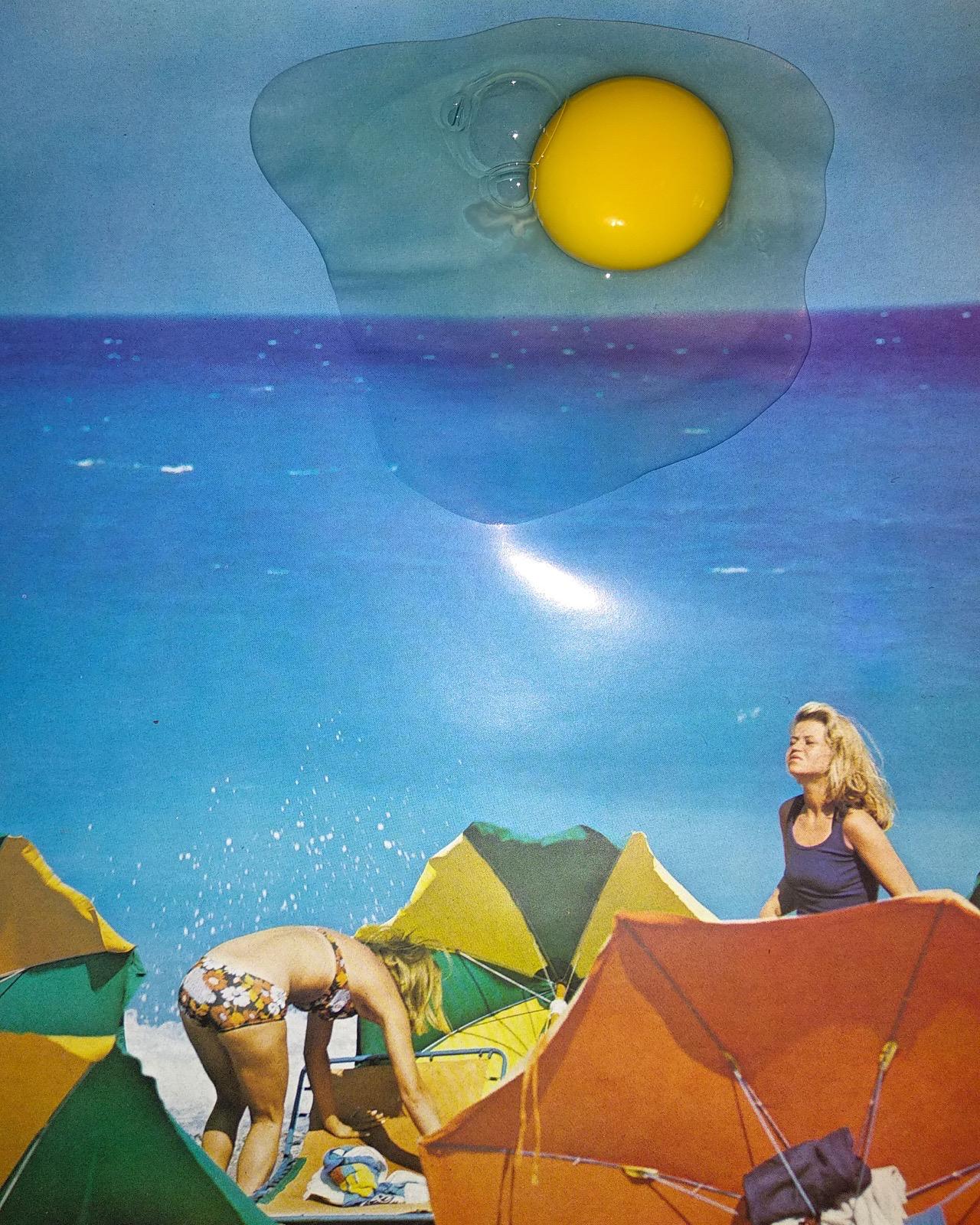
Image: Jennifer Abessira, #YouveBeenMakingTheWrongMistakes, 2018