Fungus 2
By Mia Carrillo
After Guadalupe Nettel’s “Fungus”
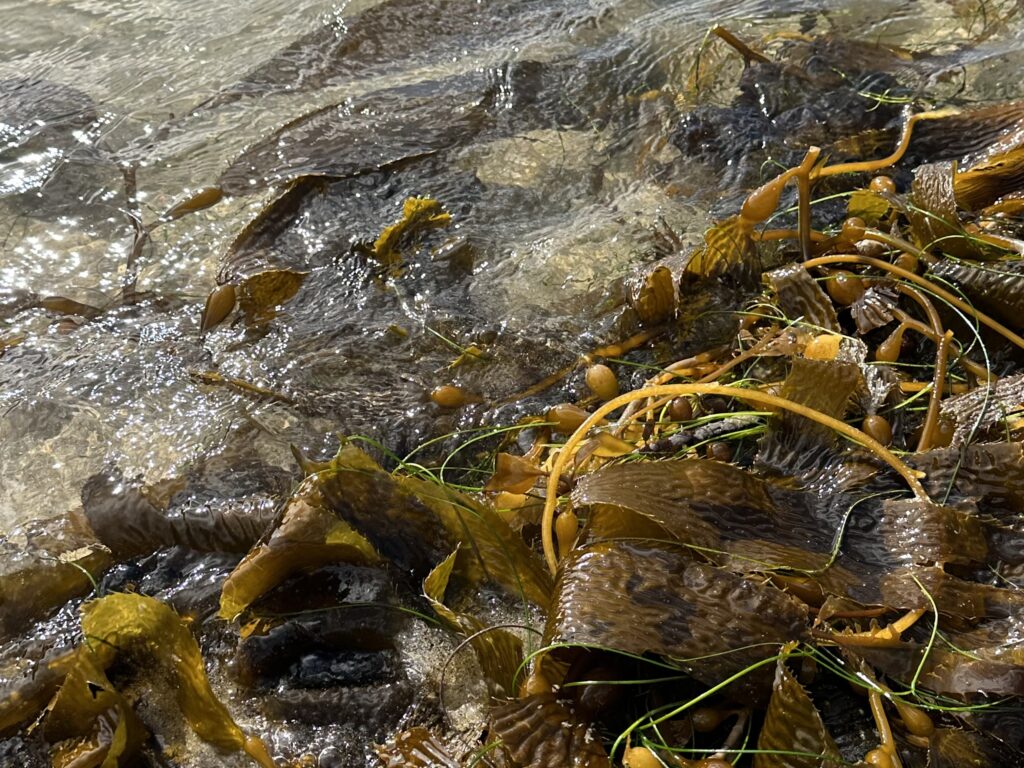
With my big toe, I pressed down on the bloated bulb of seaweed until a burst of salt air and ocean water popped out of its membrane. Amalia refused to do the same. It was her first time seeing seaweed washed up on the sand and she was repulsed by it. She touched it from a distance with a long stick as if it could stretch into a live snake, snapping at her. She said it resembled nature’s trash, with its stench of salt and compost, dark color, and the blur of flies swarming. She winced at the liquids leaking out of the broken bubble—her eyes following its alien shape, a wet home for small bugs, fermenting in itself.
I had already grown accustomed to the plant in front of us, the familiar scent and knotted mycelium soothed me. I knew that at times, beneath the canyon shade or floating at the top of the sea, the plant appeared murky and threatening—a thorny-limbed shadow with hard bumps and lumps. But under the warm sunlight, it transformed into something like sea glass, with pale yellows and bright greens, glowing quietly against the sand. It was ornamental, really, something delicate you could love. As a child, I draped the network of seaweed over my body and threaded my arms through the bright stems. The blades of kelp like an expensive scarf around my head, I played while beach bugs swarmed my body, the tendrils slapped at my skin, and my back dripped with cold slime.
Often, the weight of the plant presented a new game: I let the dark cloud of flies land on my skin, their pattering feet trilled up and down my calves, stomach, and shoulders until my body was black and buzzing. I attempted complete stillness and discipline for as long as I could tolerate, imagining that this discipline would dissolve the distinction between the seaweed and me. Slowly, I watched the brown and green undertones within my skin expand into the bright, opaque colors of the plant on top of me. The flies could not tell us apart. I, too, was nature’s trash—an essential thread in the ocean’s biome, a place to belong.
Before leaving the beach, my mother gathered water bottles she had strategically left in the car all day, the water warm in its plastic container. She instructed me to sit at the edge of the trunk with my legs spread wide and my bikini at my ankles. As she poured the water between my legs, cleaning me, my eyes followed the stream of sand running down the metal bumper in rivulets. She reminded me that if I continued these games without washing myself after, I could develop an itch—an irritation seemingly impossible to separate from.
When the heat of August rose to our ceilings, I allowed Amalia to touch me without that long stick of distance. As if it were simultaneous, I noticed minor differences in my body as I offered it up to her. First, a small pain and pressure between my legs, deeply set and dull, tugging at me while she moved inside. Then, more and more often, my underwear was stained with strange discharge, the consistency increasingly foreign to me. Cream leaked out of me, spreading over my underwear like butter. The smell mimicking sardines, impregnated me with shame, wafting through the air as I uncrossed my legs at my desk, over dinner, or in the car.
Amalia had it, too—thick, sour cream dripped out of her at random, and she itched incessantly, despite the many showers she took. I understood we had conceived a fungus. So I called my mother, who recounted my childhood: I developed infections easily, was sensitive, and demanded great care. Who has been taking care of you? she asked. The line was quiet. Not me, I thought. I looked at Amalia across the room.
I visited my gynecologist frequently, each time thinking it was the last. Routinely, I drove over the steel bridge to her office, waved hello and goodbye to the front desk. She prescribed me oral and topical medications, requiring me to slide large suppositories inside of myself each night. When Amalia saw the doctor, she was told the same. Soon, our nightly ritual was created: lying in our bed, I waited for her breath, then slowly slid the pill inside as she exhaled. We kissed, then repeated with me.
My gynecologist told me that infections like these often arise when two women are sexually active. It is how the body adapts to a new partner’s microbiome and pH levels, and may return for up to a year as my body settles into hers. Settles into hers. This phrase brought me solace, knowing our bodies mimicked our hearts: desired an intimate entanglement. The infections continued, just as the doctor had promised. As time passed, the fungus searched for nutrients in our bodies and anxiously mutated its form. Sometimes, the fluid was shiny, bright, and pure white, its residue on my underwear like tiny shards of paper. At other times, it seemed fatty and resembled yogurt, cottage cheese, or brie. Then, it was something pulpy and foamy, a crusted yellow stain on white cotton.
Eventually, I smelled and felt more like the interior of Amalia’s body than my
own. My underwear stained like hers, and my itch mirrored hers in the very
same spot. Even my smell was hers. Distance and space dissolved in front of
me, and I no longer knew where I ended and she began. I believed that we had
created our own unique gravity, pulling into and falling within the other; I
had the fungus to thank for that.
I was fascinated most by the fungus’s desires. It didn’t want to die—it bonded
desperately to our bodies. When Amalia and I spent time apart, it clung more,
the itch exacerbating day by day. It wanted to be seen, noticed, tended to in
the dark, moist environments of our bodies, and just the same, I wanted to
nurture it, to protect it as it wished. I surrendered to the control of the
infection. I became fond of it. How it eased my anxious attachment to her—now
aware that each time I felt something seep out of me, it seeped out of her,
too, and when I smelled myself, I smelled her, too. To touch myself was to
touch her. I never needed to be alone.
Surely it was no infection; it was a passion, a creation born from us, and I prayed for its life. So I ingested the fungus from her body readily. I smeared it over my cheeks and nose, swallowing the sour bitterness, and digging my tongue into its thickness. I pressed my lips over her, an oyster shell I indulged in, and she in me. She, devoted to me through the fungus, opened her mouth to its offerings. The seaweed I once draped over myself became the texture of my interior. It was as if Amalia had found the salt of the ocean inside of me, and finally, she loved it, licking it from places nobody else could touch, the whole ocean hers alone.
Nearly a year after our initial diagnosis, I woke up alone, absent from even a trace of the itch or stench left behind. The infection had abandoned me, just as she had. Or maybe how I had. Without the fungus, I could not recognize myself and it had begun to drive me mad. I self-soothed my anxiety with obsessive daydreams. I imagined Amalia as small as a scallop shell, something I could fit inside my two hands so that I could feel all of her edges, memorize them, and predict their arrival before my thumb reached the next corner. It went on like this for months—my dreaming and isolation—until we began a cycle just as familiar as the beginning. We spoke, and with each brief interaction, the infection returned, mutating in color and texture, reminding us that we could be bonded together again, if we just gave in.